The March of Folly: From Troy to Vietnam by Barbara W. Tuchman
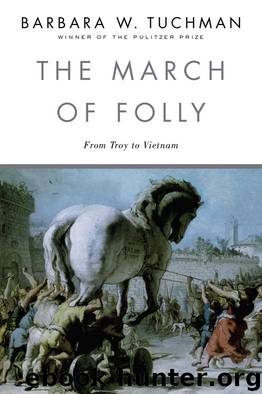
Author:Barbara W. Tuchman [Tuchman, Barbara W.]
Language: eng
Format: azw3
ISBN: 9780307798565
Publisher: Random House Publishing Group
Published: 2011-07-20T04:00:00+00:00
The immediate necessity was to relieve Britain of a profitless war in order that she might be free to meet the French challenge, and the only way was settlement with the colonies. With rumors buzzing of a coming Franco-American treaty, North, who had lost hope of victory after Saratoga, was trying to put together another peace commission against the resistance of Germain, Sandwich, Thurlow and other diehards whose minds were set against any parley with the rebels. While North agonized over what terms could be offered—not so mortifying as to be rejected by Parliament yet sufficiently attractive to be accepted by the Americans—word was received through secret intelligence that the alliance of France and America had been signed.
Ten days later North presented to Parliament a set of proposals for the peace commission so extensive in concessions that had they been ceded before the war they could well have averted it altogether. They were virtually the same as Chatham’s bill of settlement that Parliament had rejected the year before. They renounced the right to tax for revenue, agreed to treat with Congress as a constitutional body, to suspend the Coercive Acts, the Tea Act, and other objectionable measures passed since 1763, to discuss seating American representatives in the House of Commons and to appoint peace commissioners with full powers “to act, discuss and conclude upon every point whatever.” They did not yield, as Chatham had not yielded, independence or control of trade; the intention was to reattach the colonies, not to give them up.
A “full melancholy silence” fell upon the House as it heard North’s long explanation, which lasted two hours. He seemed to have abandoned the principles the Government had been maintaining for the past ten years. “Such a bundle of imbecility never disgraced a nation,” commented Dr. Johnson acidly. Friends were confounded, opponents staggered, and Walpole, the Greek chorus, sobered. He called it an “ignominious” day for government and an admission “that the Opposition had been right from beginning to end.” He thought the concessions were such as the Americans could accept, “and yet, my friend,” he wrote to Mann, “such accommodating facility had one defect—it came too late.” The French treaty had already been signed; instead of peace there would be greater war. The House was ready to approve the plan “with a rapidity that will do everything but overtake time past.” He was right; historical mistakes are often irretrievable.
To abandon a policy that is turning sour is more laudable than ignominious, if the change is genuine and carried out purposefully. The peace commission was something less. North, ever amiable but uncertain, was anything but firm. Under the turmoil of debate and the wrath of the diehards in his Cabinet, he wavered, modified terms, withdrew the discretionary powers of the commissioners and promised there would be no discussion of independence; the Americans would have to treat “as subjects or not at all.” He set twelve months from June (it was then March) as the time limit for the mission, which suggested no great anxiety to succeed.
Download
This site does not store any files on its server. We only index and link to content provided by other sites. Please contact the content providers to delete copyright contents if any and email us, we'll remove relevant links or contents immediately.
| Africa | Americas |
| Arctic & Antarctica | Asia |
| Australia & Oceania | Europe |
| Middle East | Russia |
| United States | World |
| Ancient Civilizations | Military |
| Historical Study & Educational Resources |
The Radium Girls by Kate Moore(12035)
100 Deadly Skills by Clint Emerson(4931)
Rise and Kill First by Ronen Bergman(4797)
The Templars by Dan Jones(4692)
The Doomsday Machine by Daniel Ellsberg(4493)
The Rape of Nanking by Iris Chang(4222)
Killing England by Bill O'Reilly(4008)
Stalin by Stephen Kotkin(3973)
Hitler in Los Angeles by Steven J. Ross(3948)
12 Strong by Doug Stanton(3554)
Hitler's Monsters by Eric Kurlander(3347)
Blood and Sand by Alex Von Tunzelmann(3207)
The Code Book by Simon Singh(3197)
Darkest Hour by Anthony McCarten(3135)
The Art of War Visualized by Jessica Hagy(3013)
Hitler's Flying Saucers: A Guide to German Flying Discs of the Second World War by Stevens Henry(2758)
Babylon's Ark by Lawrence Anthony(2685)
The Second World Wars by Victor Davis Hanson(2529)
Tobruk by Peter Fitzsimons(2521)
